Friday, 29 November 2013

KILIMANJARO NATIONAL PARK

      Kilimanjaro National Park

kilimanjaro-national-park

Location and size

The Park is located on the Northern Tanzania, near the town of Moshi. Its size is 1668 sq km 641 sq miles).
Getting there
It is just 128 km (80 miles) from Arusha; about one hour’s drive from Kilimanjaro airport.
Interesting features
Kilimanjaro, by any name, is a metaphor for the compelling beauty of East Africa. When you see it, you understand why. Not only is this the highest peak on the African continent; it is also the tallest free-standing mountain in the world, rising in breathtaking isolation from the surrounding coastal scrubland – elevation around 900 metres – to an imperious 5,895 metres (19,336 feet).
Kilimanjaro, the name itself is a mystery wreathed in clouds. It might mean Mountain of Light, Mountain of Greatness or Mountain of Caravans. Or it might not. The local people, the Wachagga, don't even have a name for the whole massif, only Kipoo (now known as Kibo) for the familiar snowy peak that stands imperious, overseer of the continent, and the summit of Africa. Kilimanjaro is one of the world's most accessible high summits, a beacon for visitors from around the world. Most climbers reach the crater rim with little more than a walking stick, proper clothing and determination. And those who reach Uhuru Point, the actual summit, or Gillman's Point on the lip of the crater, will have earned their climbing certificates.

What to do
Six usual trekking routes to the summit and other more-demanding mountaineering routes, day or overnight hikes on the Shira plateau; nature trails on the lower reaches; trout fishing; visit the beautiful Chala crater lake on the mountain’s southeastern slopes.

When to go
During the clearest and warmest conditions from December to February; but also dry (and colder) from July-September.
Accommodation
There is huts and campsites on the mountain; several hotels and campsites outside the park in the village of Marangu and town of Moshi.
NOTE:
Climb slowly to increase your acclimatization time and maximize your chances of reaching the summit.
To avoid altitude sickness, allow a minimum of five nights, preferably even more for the climb. Take your time and enjoy the beauty of the mountain.

have a nice journey

Tuesday, 26 November 2013

OLDUPAI GORGE

Over the last thirty years or so, it has become increasingly apparent that Africa is probably the “Cradle of Mankind”. From Africa they spread out to populate the rest of Earth. Remains of the earliest humans were found in Oldupai Gorge.

Oldupai Gorge (originally misnamed Olduvai) is the most famous archaeological location in East Africa, and has become an essential visit for travelers to Ngorongoro or Serengeti.
At Laetoli, west of Ngorongoro Crater, hominid footprints are preserved in volcanic rock 3.6 millions years old and represent some of the earliest signs of mankind in the world. Three separate tracks of a small-brained upright walking early hominid. Australopithecus afarensis, a creature about 1.2 to 1.4 meters high, were found. Imprints of these are displayed in the Oldupai museum.
More advanced descendants of Laetoli’s hominids were found further north, buried in the layers of the 100 meters deep Oldupai Gorge. Excavations, mainly by the archaeologist Louis and Mary Leakey, yielded four different kinds of hominid, showing a gradual increases in brain size and in the complexity of their stone tools. The first skull of Zinjanthropus, commonly known as ‘Nutcracker Man’ who lived about 1.75 millions years ago, was found here. The most important find include Home habilis, Zinjathropus and the Laetoli footprints.
The excavation sites have been preserved for public viewing and work continues during the dry seasons, coordinated by the Department of Antiquities. One may visit Oldupai at all times of the year. It is necessary to have official guide to visit the excavations. At the top of the Gorge there is small museum, a sheltered area used for lectures and talks, toilets and a cultural boma. Local Maasai souvenirs are also available.
Thus, Oldupai and Laetoli makes the Ngorongoro Conservation Area an important place in the world for the study of human origins and human evolution.

Discover the world as it was when we were once all African.
Visit a Modern-Day Eden.

The Ngorongoro Conservation Area (NCA) - where people and their early ancestor have co-existed with wildlife for nearly four million years. This World Heritage Site and International Biosphere Reserve encompasses a spectacular mosaic of landscape that includes the breath-taking Ngorongoro Crater and the legendary Serengeti - the annual host of the World’s highest concentration and diversity of migratory animals numbering nearly two-million strong. As if this wasn’t enough, the NCA also contains two important and internationally-known fossil and archaeological sites: Laetoli and Olduvai Gorge. Both continue to contribute significantly to understanding of humankind’s physical, behavioral and technological evolution.
The Olduvai Gorge Museum and Visitors Center offer numerous educational exhibits, including fossils and artifacts of our human ancestors and skeletons of many extinct animals who shared their world. There are also informative lectures, special guided archaeological sites tours, native handcrafts and a well-stocked bookshop. See and learn about our collective human origins when we were once all Africans.

The Laetoli Footprints: First Steps on the Road to Humankind

See and touch a huge cast of actual footprints made by our early human ancestors (hominins ) known as
Lucy" Australopithecus afarensis. The prints of three hominins were miraculously preserved in muddy ash deposited by volcanic eruptions and hardened by the sun some 3.6 million years ago.
Made by feet little different than our own, they proved conclusively that these creatures stood and walked upright (bipedally) with a human-like stride a million years before the invention of stone tools and the initial growth in hominin brain size. It’s undoubtedly one of the most astounding and important scientific discoveries of our time.
A complete room of the Olduvai Museum devoted to the hominin footprint trail.

Walk in the Grand Canyon of Humankind

Some 30,000 years ago, splitting of the earth’s surface by violent geological activity and millennial of erosion by seasonally flowing streams incised the nearly 250 foot (90m) canyon known as Olduvai Gorge. These natural forces exposed a remarkably rich geological chronicle of human ancestry and the evolution of the Serengeti ecosystem. It was here that Mary and Louis Leakey unearthed the first well-dated artifacts and fossils of some of our earliest human ancestors after over 30 years of painstaking work. These include the famous Zinjanthropus (Australopithecus boisei) skull, homo habills, the presumed maker of the numerous early stone tools in the 1.8 to 1.6 million year-old deposits, and homo erectus, the larger bodied, larger brained hominin that preceded the earliest modern humans (Homo sapiens). 

Nightmarish Flesh-Eaters Ruled the Birth of Our Early Ancestors

Similar to modern-day East African lakes, the nearly two million year-old paleolake Olduvai once teemed with large predators and gigantic plant-eaters. Clearly our ancestors lived and evolved in a brutal world where sudden death potentially lurked at every turn. They successfully competed against such dangerous competitors by seizing an opportunity created by large carnivores with the aid of a few sharp stones and refuge trees.

The Upright Apes Who Changed the World

Somewhere in the East Africa’s Great Rift Valley over two million years ago, a bipedal ape picked up two rounded fist–sized stones. Forcibly striking one against the other, he created a sharp-edged implement and several razor-edged stone flakes. By design or accident, this was the world’s most important technological breakthrough because it helped make us human. Their ability to cut open the thickest of animal hides and process and consume the nutritious flesh and bone marrow may have been the metabolic catalyst for increased brain size and our successful transition from apes to humans.

Friday, 15 November 2013

WILDEBEEST MIGRATION

THE GREAT SERENGETI WILDEBEEST MIGRATION


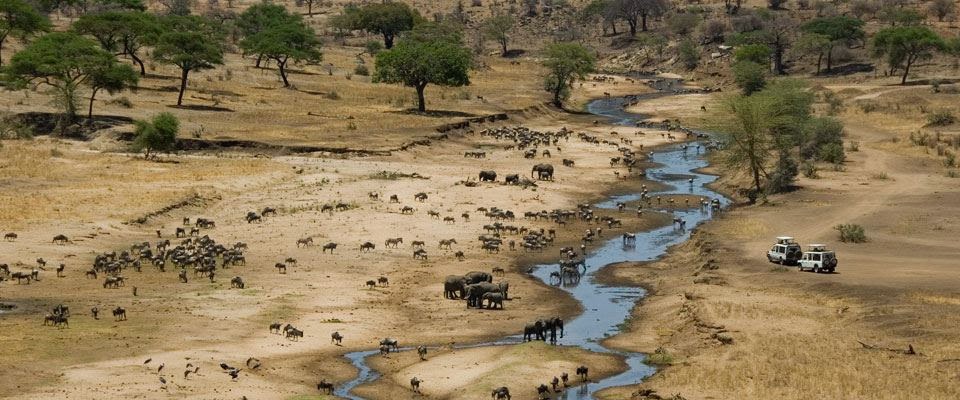
The great Serengeti wildebeest migration is the movement of vast numbers of the Serengeti's wildebeest, accompanied by large numbers of zebra, and smaller numbers of Grant's gazelle, Thompson's gazelle, eland and impala. These move in an annual pattern which is fairly predictable. They migrating throughout the year, constantly seeking fresh grazing and, it's now thought, better quality water. The precise timing of the Serengeti wildebeest migration is entirely dependent upon the rainfall patterns each year – here we explain how the broad pattern works.


Month by month: the Serengeti wildebeest migration

The short rains begin around early November. A little after this, in late November and December, the herds of the wildebeest migration arrive on the short-grass plains of the Serengeti. These are south and east of Seronera, around Ndutu and include the north of the Ngorongoro Conservation Area. Dispersed across these plains, wildebeest and zebra are everywhere – feeding on the fresh, nutritious grasses. They stay here through January, February and March, with most wildebeest calves born in a short window around February. Gradually they spread west across these plains, then around April they start their great migration north.

By May the Serengeti's wildebeest all seem to be moving north, migrating to seek fresh grazing and water. The area around Moru Kopjes and west of Seronera is then hectic with a series of moving columns, often containing hundreds of thousands of animals – joined by many zebra, and a scattering of Thompson's and Grant's gazelles.

Some of the migration then head due north of Seronera, but most are usually further west. Around June the wildebeest migration is often halted on the south side of the Grumeti River, which has some channels which block or slow their migration north. The wildebeest then congregate there, in the Western Corridor, often building up to a high density before crossing the river. The river here is normally a series of pools and channels, but it's not continuous – and so whilst they always represent an annual feast for the Grumeti River's large crocodiles, these aren't usually quite as spectacular as the crossings of the Mara River, further north.
The wildebeest migration continues moving northwards during July and August, often spreading out across a broad front: some heading through Grumeti Reserve and Ikorongo, others north through the heart of the Serengeti National Park.

September sees the herds spread out across the northern Serengeti, where the Mara River provides the migration with its most serious obstacle. This river gushes through the northern Serengeti from Kenya's adjacent Maasai Mara Game Reserve. Watching the frantic herds of the wildebeest migration crossing the Mara River can be very spectacular; there are often scenes of great panic and confusion. It's common to see herds cross the Mara River north on one day, and then back south a few days later.

By October the wildebeest herds are migrating again with more accord: all are heading south, through western Loliondo and the Serengeti National Park's Lobo area, returning to the green shoots which follow the rains on the short-grass plains of the southern Serengeti in November.
Then the whole Serengeti Wildebeest migration starts again …

Thursday, 14 November 2013

SAFARI TO NGORONGORO CRATER

             4 days safari to Ngorongoro Crater
                   Pickup; JRO[Kilimanjaro International Airport]
Picking time;
Arrive at Kilimanjaro International Airport [JRO]/Arusha on board flight at any time, go through the passport control then down to the luggage collection hall. Collect your luggage from the conveyor belt and walk out to the arrival place then you will meet our Guide waiting for you holding a folder written “YOUR NAME”

         From JRO to the Hotel/Lodge you booked.
After meet our guides your safari will start from Airport to the hotel you booked for the service you need, its better you google the hotel/Lodge you want then we will help you on booking process. You will spend time in the hotel/lodge for the time you will be waiting for safari next day.

Day 1: From the Hotel/Lodge you sleep to Tarangire National Park
Around 08:00/08:30 you start safari to Tarangire and it will take about 2 hours to reach, on the tarmac road  you will experience what the park have in Flora and Fauna.
Also you will see the herd of Elephants grazing and browsing, and a lot of baobab trees {upside down trees}, if you’re lucky enough you will see tree climbing Python.
In the afternoon you will go picnic site for lunch, there everyone must take his/her own lunch box for a short time. Then you will continue with game for some hours, after the game you will go to lodge for night spending and preparation of tomorrow’s trip.

Day 2:From Tarangire National Park to Lake Manyara National Park.
Early in the morning safari to Lake Manyara National Park  here you will see herds of gazelles , impalas, wildebeest, buffalos, bush bucks, elephants grazing and browsing. Also you will be able to see predators like Leopards or Lion{king of jungle}either resting or hunting but if your luck.
In the afternoon you will go picnic site for lunch everyone must take his/her own lunch box. After lunch safari to Karatu in a small town will start for resting and spending your night to the Lodge/hotel you booked.

Day 3:From the Lodge/ Hotel in Karatu to Ngorongoro Crater
 During morning a travel to Ngorongoro Crater will start its going to take 30minutes to reach there.Ngorongoro crater is one of the most outstanding natural features in the world its about 18km wide and 600meters deep this caldera have a lot of  large animals  and one of the best places to see White and Black Rhino. Here you will spend almost 5 to 6 hours then you will go for lunch at the Picnic site as we did before then you will go back to the Lodge/hotel you booked.

Day 4: half a day at Ngorongoro Crater
Today you’re going to spend at least 4 to 5 hours before you start a trip to Arusha town. But this will depend according to your time table {schedule} on what time your going to fly back to your country.

Itinerary includes
-park entry fee {conservation fee}
-accommodations if we booked hotel/lodge for you
-guiding fee
-transport {4 wheel drives}
-mineral water
-lunch box
-Ngorongoro crater fee

Itinerary excludes
-All luxurious things
-alcohol
-meals {dinner}
-tips
                                 

Bigger number of people price will go down and few number of people price will be up.


Tuesday, 12 November 2013

7 Days Tour to Serengeti and Ngorongoro

       7 Days Tour to Serengeti and Ngorongoro

You will have a chance to visit Ngorongoro Crater which is one of Worlds well known wildlife viewing area and also one of the largest Calderas. You will drive within its walls [610 meters deep and an area of 260 km sq] and view a variety of animals and vegetation including Grasslands, Swamps, and Forests, Salt pans, freshwater lakes and abundant birdlife.  Among the animals to be seen there are Lions, Elephants, Buffalos, Black Rhino, Wildebeests, Zebra, Gazelles,  reedbucks and a fleet of Flamingo wading in the shallow soda[Lake Magadi].
Visitors will also have a chance to see Local Maasai Tribe sharing the crater with wildlife as they graze their cattle.
And in Serengeti where the Park covers an area of 14,763sq km you will experience the sparkling, treeless plains where thousands of hoofed animals move constantly in search of fresh grassland and water. The Wildebeest numbering more than a thousands and main prey of large Carnivores such as Lions and Hyenas.

Day 1:Arusha To Tarangire National Park.
Today we drive to Tarangire National Park for excellent game viewing. Tarangire is the small park which offers excellent sights. Generally in the dry season Tarangire come alive as wildlife and Birdlife congregate on the Tarangire river which is the permanent source of water .Will spend the night in the inside the Park or outside the Park as you like.

Day 2:Tarangire to Lake Manyara.
Today we drive to Lake Manyara National Park for a full of game drives. This is one of Tamzania’s smaller Park that but still offers a rewarding and diverse safari experience. The Lake shore at Manyara teems with birdlife, and while your looking for the birds ,you might spot one of the elusive Tree climbing Lions. There are surprising number of large mammals and the striking cliffs on the rift escarpment from a dramatic backdrop. In the afternoon we make a short journey to small town call Karatu for a night either in lodge or hotel as you like.

Day 3:Lake Manyara to Serengeti.
We head towards Serengeti National Park .En route there is an opportunity to visit Olduvai Gorge. It is within this steep sided ravine that Louis and Mary Leakey made some of the worlds most important archeological discovers in the 1950s.After lunch we drive into Serengeti itself  and the rest of the afternoon  we spend game viewing in vast plans .In December, January and February we will normally meet the migration with large herds of Wildebeests, Zebra and Gazelles .There are always plenty of resident animals such as Buffalos, Giraffe and Elephants and many large predators such as Lions, Cheetah, Leopards and Hyena. Then we return to the lodge which is inside the Park or special tented campsite.

Day 4:Serengeti.
We have another full day in this wonderful Park ,rising early to make the most of our time, Our guides will choose the best spotting site for you either we can spend time at hippo pool watching this majestic animals laze about in the cool water happily living alongside the crocodiles, watch big pride of Lions be in the middle of migration sometimes surrounded by wildebeest sometimes Zebras which travel by the wildebeests. This interesting landscape will provide us with the ultimate game viewing  we will hopefully see all of plains game Elephant, Buffalos, Giraffes, Wildebeests and Lions If you lucky the elusive Leopards and Cheetahs as well as huge amount of interesting birdlife from elegant Secretary birds to the flightless Ostrich. We return to the Lodge or special tented campsite for the night.

Day 5:Serengeti again.
We have another full day here but today will be to the other  site as our guide choose which is suitable for you to see different species of animals hope your going to enjoy a lot .after gaming we return to the lodge or campsite.

Day 6:Serengeti to Ngorongoro.
We start a day with early morning game drive before heading to Ngorongoro conservation area Ngorongoro is the special place in that is conservation area and not a national park that means the whole area is managed for both animals and local maasai people who graze their cattle alongside the indigenous wildlife. During the drive in Ngorongoro will have a chance to glimpse something of the maasai way of life. After stopping at the entrance gate you will get a chance to learn more about this fascinating volcanic landscape, we will drive around the rim of the crater itself, and from here we can look down and see herd of wildebeests or buffalos then finally we descend into the crater .In the late afternoon we will drive up to a small town call Karatu for night either in hotel or lodge.

Day 7:Jorney back to Arusha Town.facebook.com


Hope your safari will be good and you will enjoy.
Your welcome to enjoy with us.thanks